

Need to create a solid content plan? Here is your 6-step guide to a 2024 content plan that you’ll actually stick to.
Here’s the thing with content plans: we are pretty good at looking at them for the first couple of weeks or so. Maybe we even batch create content for a month and feel really good about it all. This time it’ll be different. Then life kicks in and content becomes one of a big long list of things you know you should do but isn’t getting prioritised. Then before you know it, your lovely content plan is gathering dust and you’re feeling guilty. Even the best content diary or planning in the world isn’t going to help fix this.
But, I hope this guide will give you a better chance at sticking to your 2024 content plan. I’ve broken everything down, step-by-step. Follow them in order and don’t be tempted to skip the difficult stuff.
Off we go….
Step 1: Tackle the top-level stuff
When creating your content plan, the top-level thinking that you need to do first is your strategy and big-ass goal. But before you can dig into that, you need to know how much capacity you have for content so that you know that your goal is truly achievable.
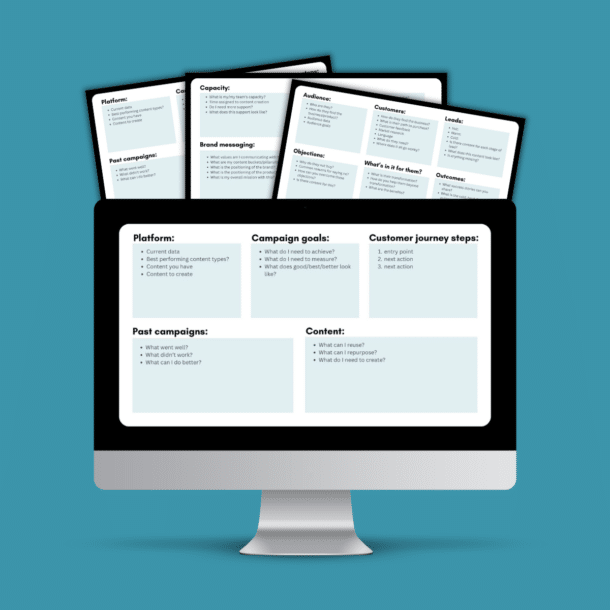
To help with this, access the content calculator here and download the content canvas here. Both of these will help you with setting the top-level thinking. As you work through the content canvas (pages 1 & 2 especially), keep your big-ass goal in mind. You’re working on the high-level thinking, not the nitty gritty tactics like what platform to focus on.
I find it helpful to have a word of the year. I know it’s a bit wanky, but it does give your subconscious a direction on which to focus. Mindset is a huge part of whether or not your content plan will succeed in both achieving its goal and getting it done. So it makes sense to work on this part first.
My 2023 word was “calm”. I’m not going to suggest my year was an abundance of calm, but it was certainly calmer than any previous year, and I’ve had more going on in the background than in any of the other 12 years of being my own boss.
Anyway, set your word and maybe stick it at the top of your annual content plan.
You’ll also need to go back over your market research (or do some if you don’t have any). It’s good to take an annual view of your data as well at this point. Look at:
- What’s worked
- What hasn’t
- What you’d like to do more of
- And what you’d like to do less of.
This will all help set that strategy in place.
Doing this first step of creating a content plan should take time, and it should be difficult. I’m not even sorry about that because it’s this foundational work that most people miss out and it’s why the content plan gets dropped at the first sign of heavy delivery.
Step 2: Split the year into quarters
You should know or have a good idea of what you’re either promoting or launching in both the first and second quarters. It’s not a problem at this point to not really have the second half of the year nailed down but the longer you’re in business, the easier this will get.
For example, I know that I will run two or three live rounds of Blog Confidence. I also know that I have the online version launching in January and I know that for my 1-1 work I have a new product launching. Plus, I want to relaunch my signature PIMP My Content Programme.
That’s a lot for a year but if I can sketch this out across each quarter then it breaks down the overwhelm a bit.
Building launches and campaigns into quarters makes it much easier to see if you’ve got too much going on or not enough. It also means you can look at how you can run campaigns between launches to build up a lovely stack of leads so that when you do launch, you don’t get crickets.
For now, I want you to ignore the brand awareness/business-as-usual stuff. That’s going to come later in the process of creating a content plan.
When looking at what’s happening in each quarter, you also need to set some quarterly goals. It might be to launch a product or to get into the swing of a regular newsletter. Whatever it is, don’t create more than one focus for each section of the year. And also don’t forget that July and August suck up a huge amount of the third quarter. You might want to think about how you’ll build that into your planning (quick tip: this is a good time of year for brand awareness but we’re not talking about that just yet).
Again, use the content canvas to help you plot this out. Yes, it might mean going over the same questions multiple times but each time you have a different focus in mind.
This is a slightly easier task than step 1 but also one that most people miss out.
Step 3: Split your first quarter down into monthly planning
Next, you want to start focusing on the first quarter.
Ask yourself:
- What is the story I am telling over these three months?
- What do I need to achieve each month to reach that quarterly goal?
- And do I have everything I need for any campaigns or launches?
Now is the point of creating a content plan at which you can start looking at the tactics. How are you going to deliver those goals and launches? Do you need more work done on your website? Which channels are you going to use? What is your on-site marketing (SEO, lead magnets etc) and what is your off-site marketing (socials, partnerships, PR etc).
Make sure you have time to do all the stuff you’re setting out to do. Go back to that calculation you made in step one. If there is any risk at all that you’re overloading yourself or your team with work then look at what is a need-to-have and what is a nice-to-have.
You will have some months that have more space and time so you can bring in the nice-to-haves but make sure you are clear on what is essential and what is a bonus.
Now is the point you can start laying this out in a content calendar or planner. I have a simple template here.
You’re only looking at the monthly row right now. Outline what you’re doing for the next three months and do not be tempted to get into the nitty-gritty.
You should also start planning out launches and campaigns for the next three months as well. This will help you see if you need to create anything new. You can plan that into your time, too. Much better than building a landing page and realising that’s only the base of the content creation mountain.
Step 4: Weekly planning
This is the point where most people start when planning out their annual content. You can kinda see how this all starts to fall apart so easily now. Personally, I like to plan what I’ll be doing each week around a month ahead. So, in December, I’ll be doing steps 1-3 first and then putting January’s weekly planning into the calendar. In January I’ll put in Feb’s and so on. Sometimes, I even go two months ahead.
This means that if something should happen, I have time to adjust it without panicking. And yes, that is a result of my word of the year for 2023.
When planning at a weekly level, it’s tempting to put in all of the graphics and copy. You don’t need this. You just need the seed of the idea. It’s why I don’t really love sharing the content calendar I use as a template because there isn’t that much to it. It’s looking at this monthly and weekly level rather than daily (which is the next step).
What is important here is to have content pillars (or buckets, or themes, or talking points) when creating a content plan.
For me, these content pillars are things like:
- Blogging
- SEO
- Content marketing
- Content strategy
- Content planning
- Ethical business
- Sustainability
- Behind the scenes
Plus there is also:
- Newsletter promo
- Lead magnet promo
- Sales posts
These are your business-as-usual posts.
But I’m getting a bit ahead of myself. It’s easy to do and it’s one of the reasons why content plans fail.
The very first thing you need to do at a weekly level is plot out where the launch and campaign content is going to go. Make sure this is done in a sprint. Which is a small burst of content where you’re trying to get people to take a particular action. You don’t want to overload this onto your content calendar as your audience and therefore leads, will get bored.
When you’ve plotted out your launches and campaigns, you next want to put in this business-as-usual stuff. What I usually do is mix up each of my content talking points across the month, making sure I promote either the newsletter or lead magnet once a week when there isn’t a launch happening.
How you arrange this is up to you and your business although I tend to keep Fridays as my fun post day, which is the behind-the-scenes stuff.
Now, if something crops up that you absolutely have to post then you can do. You’ll have the time to be reactive when you need to because all the hard work is done. If you are reactive on a daily basis, that’s when you risk a. wasting your time because it doesn’t have any strategy behind it and b. not even doing it in the first place.
Step 5: Daily planning
And we’re back to a hard step that most people miss out on when creating a content plan. When you’re planning at a daily level, it’s less about getting the graphics and the copy spot on (although you can do this a week ahead if you’ve got the time and have done all those other steps), and more about getting the habit in place.
Daily planning is essentially building the right habits. If you’re not sure how to build a habit, you start by making it simple and attaching it to something else you do. For example, you might find it easier to post before you check your emails of a morning.
My posts are usually after the school run when I sit down with that second brew. If the day doesn’t allow for that then I do it at lunchtime.
My blogs are written on a Friday first thing and this newsletter is supposedly written on a Tuesday but often is drafted on a Tuesday but polished up on a Wednesday morning.
Getting a nice, dull habit on the go is crucial to sticking to your 2024 content plan and when you’ve put so much hard work into it so far, it’d be a shame to let that all come crashing down because you don’t have a boring daily habit.
Step 6: Review and tweak
Finally, it’s so incredibly important to review and tweak your content plan. Give it a once over each month when you do your metrics reporting and a deeper dive each quarter. Some things will inevitably slip. Take the opportunity to learn from that and see what you can do to make the next month or quarter work better.
And that’s absolutely right. But if you know what your competitors and peers are saying then you can start to identify some content gaps to fill with things that they are not saying or going deep enough about.
Remember not to compare yourself to whatever it is that your competitor is doing. This is more of a ‘seeing what else is out there’ exercise than measuring yourself against another business – which is never healthy.
Just go and look at what others are saying who come up in your SEO targets. See what your competitors are putting out. Is there something you can do differently, or better?
See it as a reference point to analyse where you are going.
Creating a 2024 content plan
And that’s it. If you’ve followed these steps then you should have a lovely content plan all ready to run. Yes, it’s in-depth, no it doesn’t start with the tactics and what you’ll post each day on social media but it will be a stronger plan as a result.