

Content creation takes up a significant amount of marketing time for any business, so knowing where to focus your efforts is half of the battle. It can be far too easy to focus on one over the other and miss out on opportunities to let your future customers know that you exist. In this blog, we’re going to be looking at the pros and cons of both short-form vs long-form copy and where you’re going to get the biggest impact for B2B offers.
- Re-thinking Short-Form vs Long-Form Copy
- Pros of short-form copy:
- Cons of short-form copy
- Pros of long-form copy
- Cons of long-form copy
- How to balance your content creation time
- Off-the-cuff moments
- Thought leadership and long-form copy
- Thought leadership and short-form copy
- Content systems
- Short-form vs long-form copy
Re-thinking Short-Form vs Long-Form Copy
One of the best ways to think about long and short-form content is how they work together to produce different results for your business. In general, short-form content is one of the first things someone sees about your business. It’s the adverts, the social media posts, those bits of micro copy like your out of office or calls-to-action on your website. These are the little nudges that help your potential clients know that your business exists.
Long-form content is the in-depth look at your expertise, how your services can help and the thing which builds trust. Often, long-form content is further down the sales funnel, which means the people who read it are more likely to know who you are by this point. It means they have different needs and motivations than those who see your social posts.
Although that’s not a hard and fast rule. You can get people who find you through a thought leadership article, and you can get people whose trust in your business is built through LinkedIn alone, but those situations are somewhat rare.
And with the increase in zero-click search – where AI answers their question on the first platform so that they don’t need to click through – there is an even greater likelihood that when someone does hit your website, they already know who you are and are curious about what you do.
The answer is to get the best balance of both, that’s right for the business you’re in. We can assume that the short-form copy is working as the brand awareness content and that your long-form copy is building the trust to purchase. However, some elements can get both your long and short-term copy working much harder for your business than it currently is doing.
Pros of short-form copy:
Short-form copy has many benefits for your business when used well. These are:
- You have more opportunities to see what works – short-form copy is your testing ground
- It can be much quicker to create. Sometimes that throwaway post does far better than the one you’ve been agonising over for hours
- There is a bigger reach. This is your brand awareness content; you can crack into new audiences.
Cons of short-form copy
Short form copy isn’t the answer to everything. In fact, it can often feel as though you’re ploughing a lot of effort into social media content or your sign-up buttons for very little return.
- Short life span – you need to feed the machine more often to get the results
- It can be just as difficult to write as long-form content. In fact, there’s an argument that it’s harder as each word needs to earn its place more
- It rarely leads to sales. Short-form content is brand awareness, which is usually the start of the journey
- You need a lot to make a difference. It can feel like you’re doing a lot for very little return
- A lot of time and money is invested into short-form copy, so you need to know how you’ll measure the success.
- Results can often be over within a few days.
Pros of long-form copy
Long-form copy can really shift a business. From chunky reads like annual reports, impact reports and white papers, through to the trust-building content like thought-leadership and case studies, your long-form content works hard for your business:
- You have an opportunity to dig deeper into a subject
- It builds trust
- It shows what you’re capable of rather than just telling
- It’s usually the content that forms a big part of decision-making
- Long-form copy brings people to you: think SEO, LLM referrals, PR from appearing in other publications
- It’s an opportunity to create something truly useful, like a book
- You don’t need to write as often for long-form copy
- When you start getting results, they often last for a long time.
Cons of long-form copy
As with short-form vs long-form copy, there are downsides to its extended partner.
- It takes longer to create
- Truly exceptional long-form copy often needs in-depth research and interviews
- It can take time to see results
- There is definitely an investment of money into this as well
- As long-form content has a longer shelf life, it can be more difficult to attribute ROI
There is a lot to balance if you’re going to invest in one area over another. When I’m looking at this with clients, the answer usually lies in one of two things: what they enjoy doing and what is bringing people to the business.
For example, with a recent client, their Instagram content was important to them, even though it was only driving 2% of website traffic and even fewer leads. Whereas their long-form content was bringing in around 60% of traffic from both organic search and AI referrals. For that founder, the short-form content still mattered from a brand perspective as it was something they could showcase when networking.
How to balance your content creation time
The key to getting this right is understanding how much time or resources you have available. Then you put those resources towards the right actions. In the example, the right focus of time would be on the long-form content. This would save around 20% of resources towards the less impactful social media content.
How this looks for your business will depend on what is already driving your sales. From experience, this is often the long-form content simply because it better demonstrates what is possible and builds trust.
This is also where long-form copy is more powerful as a starting point because your short-form content can come from these bigger, more in-depth reads. Firstly, it means you’re not digging around for content ideas; you’ve already got them. Secondly, you’ve done the work; you simply need to cut it up. Thirdly, when you’ve saved time by using your long-form to feed into your short-form, you can better respond to those off-the-cuff moments that often have a bigger impact.
Off-the-cuff moments
Many of the LinkedIn posts that seemingly do well are often last-minute and thrown together. It’s something that has taken you in the moment, and it may do well because you’re tapping into timely thoughts.
One of my own “viral” posts was a story about my daughter being told to make her sentences more passive, as this will help her pass a test. I was quite rightly exasperated by this. I did a quick post on LinkedIn after the school run. It took me less than 10 minutes to write, and as an afterthought, I posted one of my professional photos alongside it.
Within the day, people I didn’t know were commenting. Within the week, it had all gone a bit nuts. The admin to maintain the replies to the comments was already eating into my work time, and I had to let it do its own thing.
The idea is that you have time to think about these off-the-cuff posts because you already have a plan in place for your business-as-usual posts. When you do get one that picks up a bit of steam, it means your other content gets noticed as well.
It’s even better when this kind of post talks to your audience about your core thought leadership topic, but that’s even more rare. Quite often, posts do well because you’ve hit a nerve, related to people, or they can recognise themselves in what it is you’re saying.
Thought leadership and long-form copy
Good thought leadership is built on long-form copy. It needs to be in-depth to showcase your expertise and why your insights are different to everyone else out there. Service-based businesses are built on the founder’s personality (many product businesses are as well, but to a lesser extent).
Copy for the personality
One of the benefits of long-form copy that I didn’t touch on earlier is how it can be hugely beneficial for introverted people. Those of you who shirk away from posting on any social platform and would much rather be doing the work than shouting about how brilliant you are.
Long-form thought leadership copy allows you to share your expertise but without feeling as though you’re doing it in a performative way.
For example, you might have built a great AI platform that can help your customers. You don’t want to be posting every day on LinkedIn. You network because you need to, but you also know that you have a limited reach this way. Instead, thought leadership articles can help you articulate your core ideas in a way that feels more comfortable. There is no need to be front and centre on video or chasing down trends. You simply put your thoughts down in a coherent way about how your business will change someone’s world.
How you then disseminate this information is down to what you’re comfortable with. That might be a series of LinkedIn posts, it might be talks or podcasts, or it might be sharing your writing on third-party platforms like Ghost, Medium, Substack or BeeHiiv. It may even be pitching your articles to industry press or associated businesses.
Even when you’re comfortable on social media, it’s easy to overlook other ways to tap into a wider audience because you find putting out a post more straightforward. Or, you might be like my client, who values a social media channel as a showcase when they are networking.
Thought leadership and short-form copy
There is a pervasive myth that thought leadership IS posting on LinkedIn, and this could not be further from the truth. The majority of posts that you see on LinkedIn lack any depth to be described as original thoughts, and when you do get a post that matters, it is not guaranteed to be sharing that person’s core message.
That is not to say that you cannot get thought leadership posts on LinkedIn. These are different to what LinkedIn calls thought leadership ads. Often, the truly excellent thought leadership posts have come as part of a planned and well-executed argument. They follow a theme and are directed at specific audiences.
Moreover, when it comes to short-form copy, thought leadership content is spilling down from much deeper thinking that is published on the channel and elsewhere.
Consistent posting
Recently, I did a review of 100 founders and found that consistent posting on the channel is a challenge for them. This chart gives you an overview of how often founders are posting, but what it doesn’t show is how consistent they are or if there is any substance behind those posts.
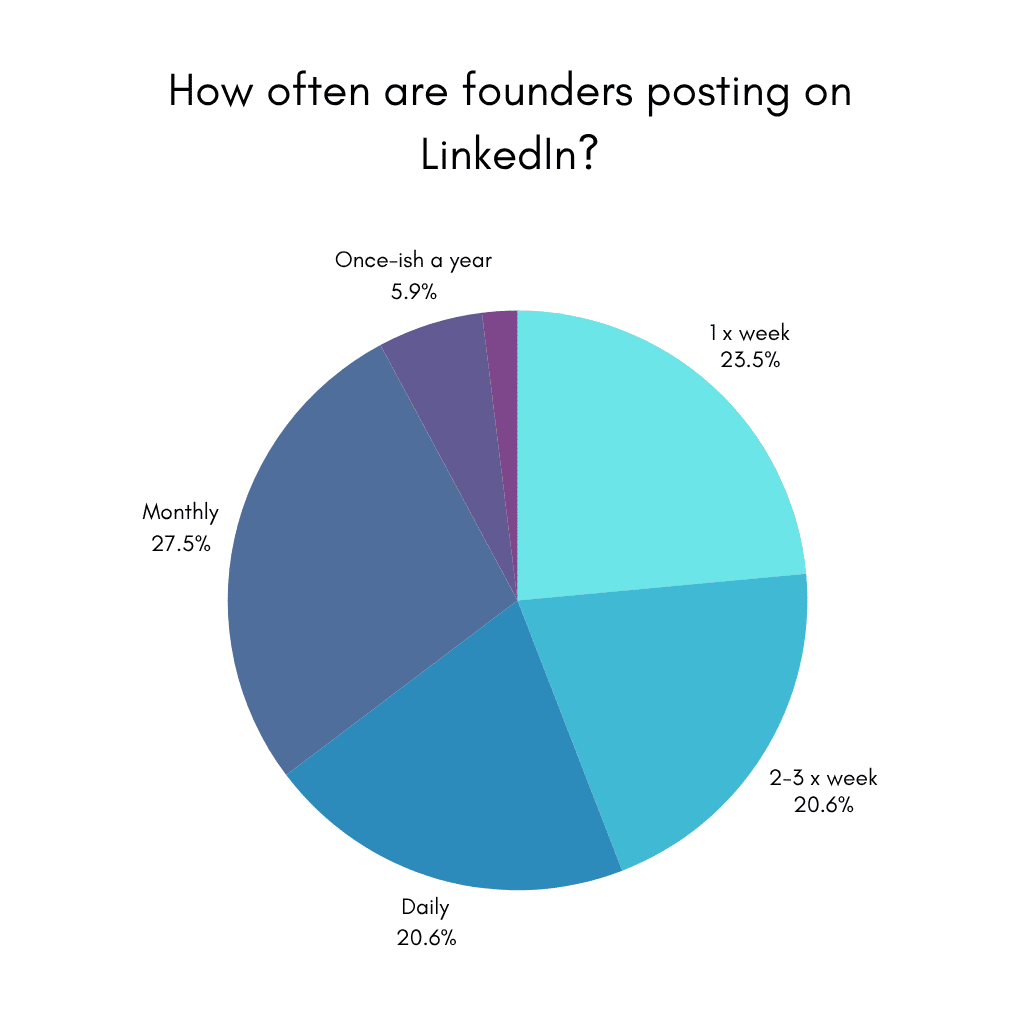
When reviewing the content of these 100 founders, I noticed a trend of posting in bursts over the space of a month and then crickets for the next three. Usually, the burst comes when there is something to sell. Makes sense that if you want people to buy your services, then you post about it. But herein lies the problem. If you’re posting consistent content, you’re more likely to have your important posts get a better reach when you do have something to launch.
Another hiccup was the founders’ reposting of the business page posts. There is nothing wrong with doing this as long as it’s not all that you’re doing. But really consider what the purpose is if you’re not adding anything extra to those posts.
Short-form copy has its purpose for thought leadership content. Certainly, many of my clients have gained brand awareness and a greater audience reach as a result of strategic posting. Yet, to get the most out of your time, you need to have a solid system in place.
Content systems
Content systems are integral to any strategy, more so when we’re facing a glut of posts and AI slop. Having the right system in place for your business is becoming more critical, especially as the way people gather and disseminate information changes.
We could once say that if you had a core piece of content, you’d break that down into your short form copy, but that’s not enough any more. These long-form pieces work their best when they come from a unique core argument.
In doing so, you test which angle hits the most, which gets the most traction and what people truly care about. From here, you can then develop this further into talks, books, podcasts and so on. The system needs to work for you, your business and your ideal client. That will look different for every founder.
You need to know exactly how each publication will cascade into the next because short-form vs long-form copy isn’t simply about articles and social media posts; it’s also the system that supports the sales journey. These are the tools and templates that people download, the Notion frameworks which you might create, the testing areas, or email marketing. All of this needs to flow in a way which feels seamless.
When short form vs long form copy integrates well, it reduces friction from the point at which someone discovers you, to the point at which they decide they need your services.
Short-form vs long-form copy
From experience, when it comes to B2B industries, long-form copy is where the focus should land. Short form copy simply supports this and should often feed from those core pieces. That is not to say we should ignore short-form copy. It is important and it has its place. We all know that one change to a call-to-action can make a significant difference.
Yet, given the challenges of how AI is changing search and engagement, long-form copy is one way to clearly demonstrate why you are different. Let’s also not forget that the LLM platforms still scrape their results from the main search engines, with a focus on expertise and trust signals.
Moreover, for our clients, expertise and trust are going to be more important than ever in the coming years, making long-form copy more essential than ever, with thought leadership being the thing to make you stand out through your unique take.