Sustainable content is good for business, your energy levels and the planet. In this blog, I’m breaking down what you need to do to create sustainable content and why you need to do this now.
What do we mean by sustainable content?
Let’s start with a definition of sustainable content because surely all content is sustainable. We’ve got to look at sustainability from both angles: the impact on the planet and the impact on us.
From the carbon emission side, the internet has a lot to answer: the internet contributes more carbon to the atmosphere than the aviation industry. You can fly the entire population of London to New York and back for the same carbon that TikTok pumps out in a year. And a day of Chat GPT prompts can fuel 5.5 homes for a year.
Most of this is created by the big servers that handle all of the data. All our online activity requires a lot of data activity. That takes place in these big servers which heat up the more they work. At the same time, servers are a bit like the shadow monster in Stranger Things: they like it cold. So that’s more carbon pumped out as the air con tries to keep these places cold while they pump out the heat.
It all adds up to a pretty dirty industry, of which we are all responsible in our own little way.
Now, I’m not telling you to quit your TikTok habits, and down tools on the online marketing. But I advocating for a more sustainable approach. Being a little more considerate about the content we produce so that we do our bit to lower the carbon emissions.
But that’s not the only side of sustainability. The other aspect is our energy and wellbeing. Around half of social media managers have experienced burnout. It doesn’t matter how big or small your content team is, everyone working in this area will feel the pressure to put out the content, keep up with the changes, adapt to the latest platform, to always be present for brand awareness.
And that’s not a sustainable approach. For businesses, it means you’re going to lose money when your content team hit the wall. For the founder-run, team of a few, the risk is greater. You cannot afford to not be present in your business or bring your best. The business is you.
So, it’s really important that we make time to create sustainable content because the reality is most of our content doesn’t get traction anyway. Sure, we can’t always predict what will and will now but imagine if we worked towards only putting out content that we knew would make an impact.
How much difference would that make to your business? To your health?
When we talk about sustainable content, what we are really saying is the content we create is having a true impact on our business. It’s not a wish and a prayer but has a strategy and deep-level thinking behind it.
Carbon-heavy content forms
Some content is more carbon-heavy than others. Funnily enough, that content is the hardest to create. This means we should be using these either with intent or sparingly.
Carbon-heavy content includes:
- video files
- audio files
- PDFs
- large images.
Anything that makes your webpage slow to load, will emit more carbon. This is why having a light website with a fast loading speed is good for both your SEO and your emissions.
You can offset some of the impact of this content by using a green server provider. This means that the servers hosting your content are fuelled by sustainable energy. It’s still pumping out the heat but it’s not causing quite so many problems.
TikTok is reportedly moving its servers to sustainable energy. It’ll be interesting to see how many other big social media platforms do the same.
If you can work on what you can control and open the dialogue about what you can’t control, then it’s a good start for your business.
There are other ways you can reduce your content footprint. Using shared files on the cloud reduces how many times a PDF is sent. Hosting video audio files on specialist platforms reduces the server demand. Even the font you use has an impact on how dirty the content is.
It can feel like an overwhelming task trying to do this but instead of thinking about everything you could possibly change, instead consider why you’re doing it in the first place. Creating content with intent, that you track and which reaches its goal is far better than churning it out in the hope that you’ll hit the jackpot.
Sustainable evergreen content
The most sustainable content is the evergreen kind. That’s the big traffic-attracting blogs, the lead magnets which bring in the leads, the email campaigns that you know when you send them, you can hear the sales bell ringing.
Getting this kind of content right needs big thinking behind it. The businesses that have a steady stream of sales from a focused content system are the ones which have put in the hard work at the start.
If you want to create this kind of content system, you need to understand what is going to sit at every level of your customer journey. Your content needs to drill down deep into that customer’s needs and wants, and it has to be thoroughly tested.
SEO is a prime example of how you can create evergreen content to drive traffic, build trust and create sales. Core content may take time to build up but when it does, it can maintain that momentum for long after its creation.
It’s important to add here that SEO on its own is not enough. You need the system around the landing pages to drive the sales. That means creating a few high ranking blogs are only as good as the next stage of the journey. People are seeing your blogs but then what? How do you get them to buy?
A true sustainable evergreen content system will cover every step of the journey, it will test it, benchmark it and most importantly, see consistent results. Until you are at that point, you need to keep digging into where else you can improve your evergreen content.
The good news is that once it’s done, you then need to support and maintain rather than consistently create something new.
Sustainable fresh content
You can’t ignore fresh content, tempting though it might be to rest on your laurels of achieving a higher state of passive income. People change. Their needs and behaviours change. You also cannot assume you’ve reached the whole market with an evergreen campaign.
You need your fresh content to be sustainable. It’s within fresh content that there is a greater risk of churning and therefore burnout.
Again, this comes down to getting the deep thinking in first before creating tactics for the tools you plan to use. If you are going down the vertical video route, it’s about how you’re going to reach the eyeballs that need to see it. How do you adapt to change without getting stuck in a loop of reacting to every new meme or trend?
Jumping on the right trend is important. You don’t want to miss an easy opportunity but to do that, you need to recognise when you’re distracted by the shiny object and when you’re genuinely going to benefit from going down this route.
Ask yourself:
- Does this fit in with my current strategy?
- Will this detract or work towards my end goal?
- Is this opportunity worth my time?
Knowing that everything will ultimately work towards your end goal can help you make clear decisions about what you need to react to and what you can ignore.
One of the best ways to approach fresh content is to give yourself some structure. This looks like content pillars or talking points that you use to filter all of your fabulous content ideas. Then, if you get a brilliant idea (or side-tracked by some well-meaning person who tells you what you should be doing) you can see if that fits within your well-researched content pillars. If not, then move on.
Sustainable workflow
One of the easiest ways to make sure you’re creating sustainable content is to establish a content workflow. This is essential if you’re working in a team but is also important as a one-person marketing bod.
Your content workflow should be the process you use to create the content but it should also include how someone flows through your content system so that you can plug gaps.
A simple content workflow could be creating an SEO blog, breaking it down for social media content, building it up for a white paper and delivering chunks on your email marketing. One main piece of content should flow outwards into all your activity.
This means if you’re using either video or audio as part of your strategy, you then need to break the blog down into other media and that media down into further content. For example, your SEO blog might have an instructional video embedded. The audio can be extracted for a podcast and the video snipped for socials.
One of my clients is running a regular webinar session. I’m taking this to create a blog, social posts and website content. When there is a library of these, we can put them together to create a course. Having that plan in place before launching the first session gives more guidance and direction to the project. It also means we’re getting the process in place for all the content repurposing ahead of time.
It saves time and allows for more reactionary content when needed.
Sustainable content ecosystem
Finally, you need to look at the wider content ecosystem to make sure that’s fully sustainable. Here, we are looking at how all the content feeds into each other. So if one lead comes through SEO and another through social media, they both get the next piece of the puzzle.
Some of your content will be specifically for cold leads, some for warm and you’ll have content for customers. If you’re a larger organisation, you’ll also need internal content to support what your staff are doing.
Plotting this out alongside a customer journey will help you focus on the gaps rather than wasting time trying a new approach.
I cannot emphasise enough how much having a content ecosystem mapped out will help you with content marketing. It will stop you from feeling like you’re on a treadmill and will support that workflow we discussed earlier.
Like the content pillars, a content ecosystem map will also add control over what you produce. If it doesn’t fit into the map, do you need it?
How to create sustainable content
I have a four-point framework that I use with clients to help them create sustainable content:
Purpose – why are we doing this in the first place?
Impact – what difference will this make for the business?
Momentum – do we have the time and capacity to maintain this in the long-term?
Profit – will this ultimately lead to a sale?
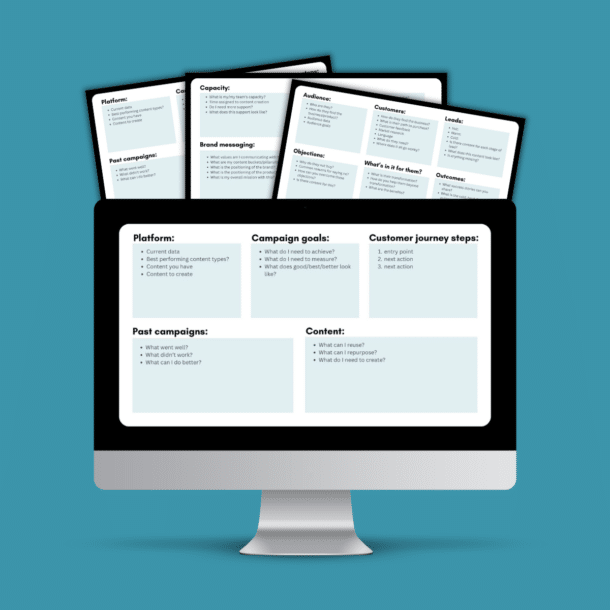
If you can’t answer one or all of those questions, then you need to reconsider what you’re doing. To help you with this, I’ve created the Content Canvas which asks key questions for creating sustainable content. Download it here.